

Two dust removal systems can leave the same percentage of fines in the clean output and send very different amounts of good regrind to the reject bin. To compare them, weigh the feed, clean output and rejects from the same batch. Use a sieve to check how much of each sample falls inside the agreed particle-size band.
Agree on three streams: A is the feed, B is the clean output and C is the rejected material. Before testing, identify every discharge and the safe sampling and collection points provided for the equipment. Agree on a method that does not require opening running equipment. If a stream cannot be collected or measured, record that limitation before interpreting the result.
Check where the material goes
A cyclone can receive regrind from a conveying line. Some cyclone systems also separate fines. Look for the actual material and air paths on the proposed layout, and ask the supplier to mark where you can collect clean output and rejects. The name of an attachment tells you little about what it takes out of your material.
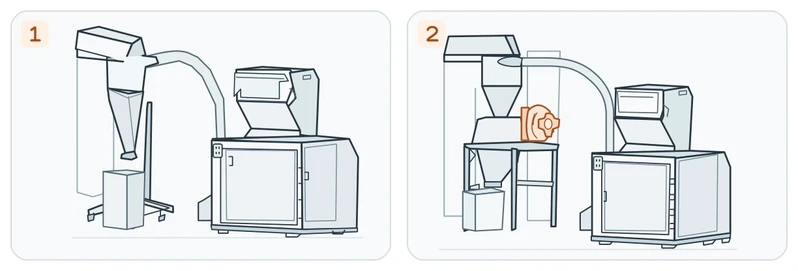
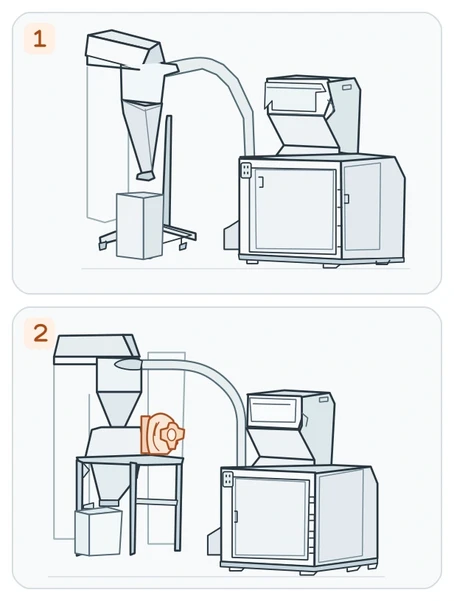
The RG-26GQ/36GQ catalogue (page 2) lists conveying as standard and the dedusting device as optional for the models shown in that edition. Confirm the layout and supplied parts for the machine you are quoted. For other discharge arrangements, see the granulator discharge and collection guide.
The old RHONG machine video at 0:14 shows the external vessels beside the granulator. At 0:30 you can also see the main duct and a side hose. Use the clip to recognize the parts when you review a quote. It contains no measured separation result.
Agree on the trial before taking samples
Use the same identified resin batch and agree on a comparable feed range and collection period. Record the equipment and settings each supplier uses to meet the same targets. Their machine settings can differ. Specify the intended production equipment and conditions alongside the actual trial equipment and conditions, including any differences that could affect the comparison.
Agree on the sieve method and openings, the fines cutoff, and the lower and upper limits of the usable particle-size band for the intended application. Set these limits for the actual material and molded part. Define the maximum acceptable fines fraction in B, the maximum acceptable usable-size loss in C, and the mass-balance tolerance before the trial.
Measure the full feed mass and the full mass of every collected output over the same collection window. Weigh and sieve a representative sample from each stream separately. To check the balance, subtract B, C, any other measured discharges and the net increase in material held in the equipment from A. Record any uncollected material separately. Investigate a balance difference outside the agreed tolerance before accepting a result. If downstream conveying can change the material, identify and test a separate downstream point rather than treating the machine-side result as the final material condition.
Same fines level, different losses
Hypothetical example. Each option processes 100 kg of the same batch. Assume 4 kg of fines in the feed, with all remaining material in the agreed size band. Nothing is retained or goes uncollected. Option 1 produces 96 kg of B and 4 kg of C; option 2 produces 90 kg of B and 10 kg of C. Both B outputs contain 1% fines by mass.
For option 1, B contains 96 × 1% = 0.96 kg fines, so C contains 4 − 0.96 = 3.04 kg fines and 4 − 3.04 = 0.96 kg usable-size material. For option 2, B contains 90 × 1% = 0.90 kg fines, so C contains 4 − 0.90 = 3.10 kg fines and 10 − 3.10 = 6.90 kg usable-size material. On the same clean-output limit, the second option would discard nearly 6 kg more usable-size material.
In an actual trial, calculate C's usable-size mass as the full C mass multiplied by the usable-size fraction in its representative sample. If reporting loss as a percentage of usable-size feed, divide that mass by the full A mass multiplied by the usable-size fraction in A's representative sample. Use your own recorded weights and fractions. Check suitability for the molded part separately.
Regrind dedusting trial sheet
Print one sheet for each option. Use the same batch, targets and measurement basis for both. Leave unknowns blank and attach sieve records and any additional stream measurements.
| Date / option / supplier | |
|---|---|
| Resin grade, batch and regrind source | |
| Intended production equipment and conditions | |
| Actual trial equipment, layout and settings | |
| Feed range / collection start, end and duration | |
| Sieve method and openings / fines cutoff | |
| Usable-size band: lower and upper limits | |
| Maximum B fines fraction / maximum C usable-size loss and basis | |
| Agreed mass-balance basis and tolerance | |
| Other streams, inventory change, collection limits and downstream point |
| Record | A — feed | B — clean output | C — reject |
|---|---|---|---|
| Safe point / time window | |||
| Full collected stream mass (kg) | |||
| Sample ID / mass (kg) | |||
| Fines by mass (% of sample) | |||
| Mass in agreed size band (% of sample) |
Other measured streams / inventory change: Balance difference and basis: Within agreed tolerance?
B fines result vs limit: C usable-size mass = C full mass × C usable fraction:
Optional loss % = C usable-size mass ÷ (A full mass × A usable fraction) × 100: Result vs limit:
Observations, downstream result and agreed next step:
Use the results to compare quotes
Send the material identification, planned layout, production conditions and completed trial sheets with the required B fines and C loss limits. Ask each supplier to state what is included, where each stream can be collected and what conditions support the proposed result. If excess fines originate at the granulator, use the fines troubleshooting guide to investigate the upstream process too.
If the trial calls for a new granulator, review the soundproof granulator configurations. Send RHONG your trial notes or ask which collection and dust removal options can be included in a quote.