
Map the route from outlet to destination
Start with the intended destination: a collection bin, an intermediate storage point or a receiving point for the next process. Show their positions relative to the granulator and describe whether material will be moved manually in batches or transferred by equipment. Record whether regrind reaches the receiving point continuously or in batches, and how it will be taken from there.
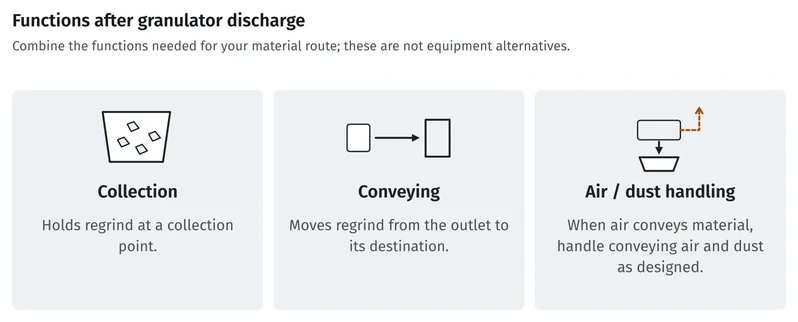
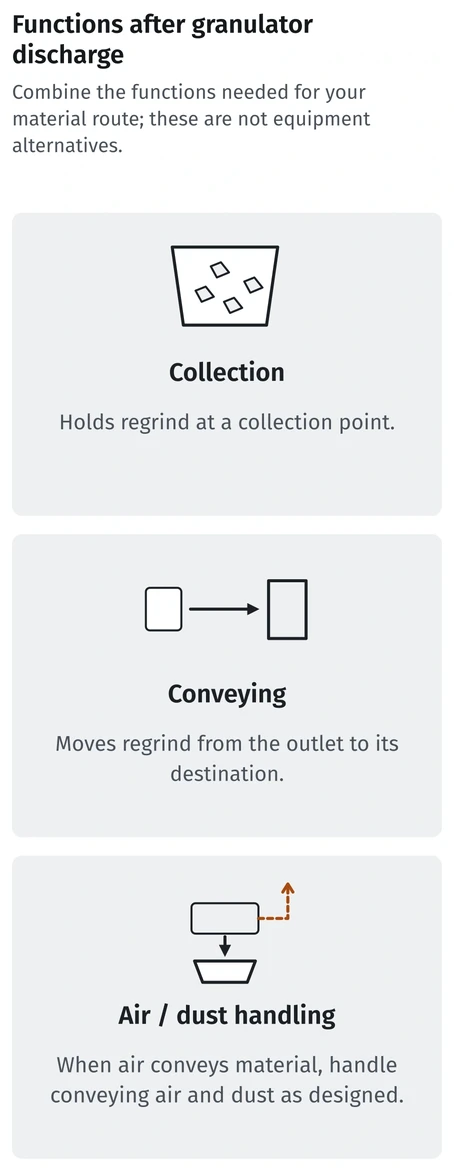
A bin collects regrind at a location; it does not by itself transfer it elsewhere. A conveying arrangement moves material along a route, but still needs an appropriate receiving point. Depending on the application, a system may combine collection, conveying and separation, or use only the functions needed for that route.
Describe the polymer, scrap form, required regrind size and operating pattern. Irregular regrind should be assessed for the proposed route; a system described for pellets should not automatically be treated as suitable. Compare the space around the outlet, path to the destination and access for cleaning with the actual layout.
Separate conveying from air and dust separation
Air conveying can use different arrangements. A blower discharge, a vacuum take-off and a compressed-air venturi are distinct examples; the name of one component does not describe every air conveying system. Conair lists blower evacuation and vacuum take-off options for its 12 Series Viper, while its CAML-EVB system illustrates compressed-air venturi transfer.
Where air carries material, the receiving arrangement must deal with both material and conveying air. A cyclone can have a role in separating the conveyed material from air without removing all dust from the regrind. In Hellweg's described system, the conveying cyclone receives granulate with dust and further equipment separates dust afterwards. Identify the job of each proposed component and where collected dust goes.
Moving regrind and meeting a particle-quality requirement are separate questions. If fines matter to the next process, define a sampling and measurement method as well as the destination. The fines guide explains why a representative sample and a consistent comparison method matter.
Compare the complete supply boundary
| Part of route | Details for the quotation or site plan | Interface to resolve |
|---|---|---|
| Granulator outlet | Proposed discharge arrangement and connection point | How material leaves the machine and connects to the next item. |
| Collection and transfer | Bin or conveying equipment, route and included pipework or connections | Who supplies and installs each section, and where material is handed over. |
| Receiving point | Destination, capacity needs, access and any required level sensing | What happens when the receiver is full and who provides the related controls. |
| Air and dust | Any air/material separation, dust collection and disposal provisions | What each component is intended to remove and where air and dust go. |
| Site services and upkeep | Electrical or other service needs, control connections and access for cleaning and maintenance | Division of installation and operating responsibilities. |
Do not infer a complete system from a single equipment name. The RG-36E catalogue description distinguishes collection box, blower and dedusting arrangements; it also describes screw discharge for RG-36ET and dedusting for RG-36ED. Specify the exact model, equipment supplied and connections in the quotation.
Fit the route to the workshop
Consider the whole path when choosing a machine location. A nearby bin may suit a batch collection arrangement, while a remote receiving point calls for a plan for the transfer route, connections and handover at the receiver. The route must also leave the access required by the equipment documents; trained personnel should use the applicable instructions for cleaning and maintenance.
The beside-the-press versus central granulation guide helps compare where cutting takes place. Add the outlet route and receiving point to that layout, then use the same drawing to compare each quotation's equipment and site responsibilities.