What changes when there is no screen?
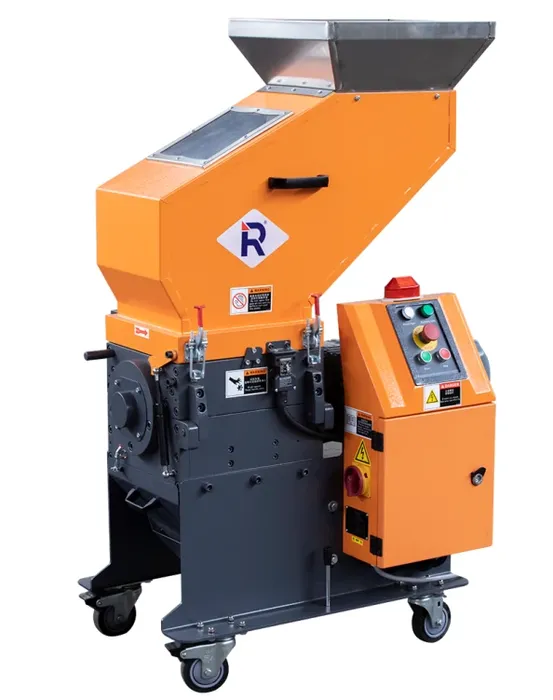
A screenless granulator reduces material without a sizing screen. RHONG's RG-27R screenless granulator uses a tooth and breaker arrangement for small sprues beside the molding machine. The runner still has to fit and pass through that cutting arrangement; screenless does not mean bladeless.
A screened granulator includes a screen in its processing configuration. The published RG-16R/21R beside-the-press granulator specifications list a screen. Its hole size is one selection variable, not a guarantee of every dimension of every particle leaving the machine.
One runner per cycle or a batch of nested runners?
Feeding one runner per cycle and feeding a batch of nested runners are different tasks, even when the scrap comes from the same mold. Describe the complete runner shape, its largest dimensions and thickest section. Add the resin grade and any filler. A photograph with a scale and a representative sample tell the supplier more than the injection machine's tonnage alone.
Show whether runners nest together and explain how they arrive: one per molding cycle, several together or an accumulated batch. Include the feed interval and the condition of the sprues at entry. Whether they need to cool before feeding is a question for the proposed configuration, not a rule to infer from the words “low speed.”
The RG-27R's small-sprue application does not establish suitability for every runner or resin grade. A screen on another machine is no substitute for checking its feed limits either.
Compare samples under the same conditions
Rotor speed alone cannot rank output or noise. Use representative material and the intended feeding pattern for the comparison, and keep the basis of quoted output and sound figures with the quotation. Figures from different materials or operating conditions are not a direct comparison.
Agree on what a sample evaluation must show: particle sizes, fines and the ability to handle the production feed cycle. Screenless does not mean dust-free. Neither arrangement has a universal advantage in output, noise or energy use.
The regrind still has to suit the molded part
RHONG's RG-27R description refers to blending recovered material with virgin resin in a specified proportion. It does not establish unrestricted replacement of virgin material. State the intended blend and the finished-part requirements before accepting a configuration.
Regrind that looks acceptable has not, by appearance alone, demonstrated that it will preserve finished-part properties. Evaluate it in the intended molding process. Feed handling and reuse acceptance belong in the same purchase decision; a machine comparison is incomplete without both.
Product references
The equipment descriptions above use RHONG's Chinese catalog entries for RG-27R and RG-16R/21R. Published catalog information is a starting point for configuration review, not a performance guarantee for a particular material.