
A rotor description can mix several different ideas: the shape of the rotor body, the way its knives are arranged, and the geometry of the cut. Separate those details before comparing quotations. A knife count or a name such as “V-cut” alone does not tell you how the whole cutting chamber is configured.
Read the description in layers
Imagine two quotations for the same plant scrap. One says “open rotor, staggered knives”; the other highlights “V-cut” and a different knife count. These descriptions are not necessarily opposing alternatives. They may describe different aspects of the cutting assembly, and each supplier may use its terms differently.
| Aspect | What the term can describe | What to compare |
|---|---|---|
| Rotor body | Open or closed describes the construction of the body carrying the rotating knives. | Ask for a drawing or photograph that shows the actual construction. |
| Knife arrangement | Staggered describes how knives are positioned relative to one another. | Look at their positions across the cutting width, not just the total number. |
| Cutting geometry | V-cut describes a cutting geometry; it is not by itself a complete description of the rotor body. | Check how the moving and fixed knives meet and how the supplier describes the configuration. |
| Moving and fixed knives | Rotating knives work against fixed knives in the cutting chamber. | Compare both sets, their arrangement and the effective cutting width. |
| Supplier designation | Names such as claw blade or flat blade identify a supplier's stated arrangement. | Obtain the corresponding configuration description rather than assuming those names mean the same thing across suppliers. |
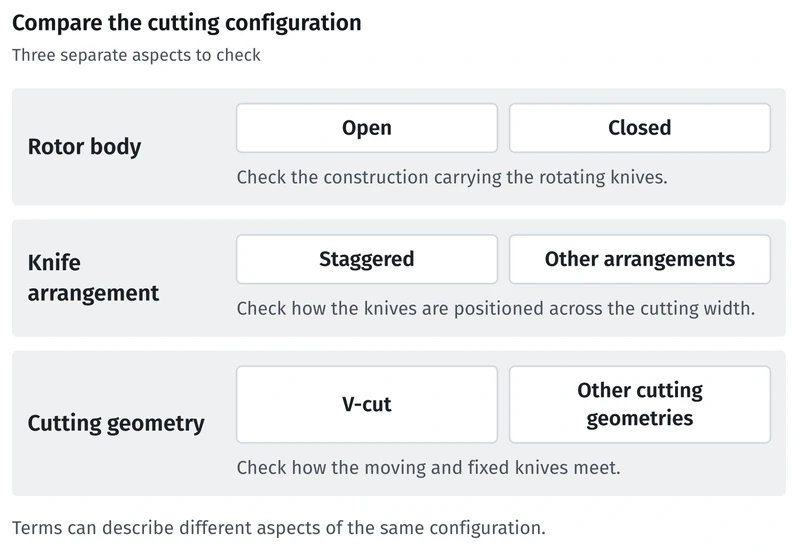
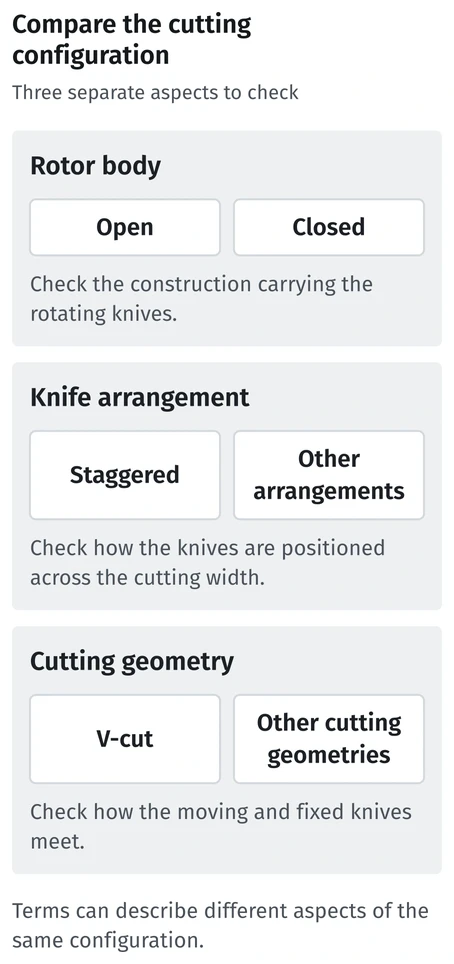
These layers can overlap. For example, a rotor body and a V-shaped cutting geometry can both be part of the same machine description. Cumberland's overview of rotor options illustrates why body construction and knife arrangement deserve separate attention. Use such terminology to frame a comparison, then check the actual design in each quotation.
Start with the scrap the knives must handle
Resin alone is too broad a description. A bundle of thin runners, a thick molded part and a compact lump can enter the chamber and meet the knives differently even when they contain the same polymer. Record typical shapes, plus typical and maximum dimensions and wall thicknesses, as well as whether the feed is loose, bundled or contains occasional larger pieces.
Material temperature and feeding method matter too. Material arriving warm from production may behave differently from cooled scrap; a steady feed presents a different demand from intermittent batches. Discuss how the proposed arrangement engages the material and whether pieces can move or bounce in the chamber. Heat build-up is another condition to evaluate for the intended material and duty, not a result that can be predicted from a rotor name alone.
Before comparing cutting arrangements, check whether the largest pieces can enter the machine and be handled by the chamber. The distinction between feed opening and cutting chamber size helps make that question more precise.
Put quotations on the same basis
A useful comparison pairs the machine configuration with the same description of incoming material and desired output. More knives are not automatically better: the complete arrangement and operating conditions determine what the number means. Use the table below to expose differences that a short model name can hide.
| Comparison item | Record for each offer | Why it matters |
|---|---|---|
| Construction | Rotor and chamber drawing or photograph, plus the supplier's terminology | Shows what the names refer to. |
| Cutting assembly | Effective cutting width, rotating and fixed knife arrangement, knife count and cutting geometry | Makes the described configurations comparable without treating one label as the whole design. |
| Operating configuration | Rotor speed and screen opening, together with the stated feeding method | Shows the operating conditions specified with the cutting arrangement. |
| Material basis | Resin, part shape and dimensions, wall thickness, temperature and expected feed pattern | Prevents a result for one feed from being mistaken for a result on another. |
| Results and output | Comparable sample-material results and the required output characteristics | Connects the proposed configuration to the actual procurement requirement. |
| Ownership | Knife and screen identification, replacement parts and maintenance requirements | Lets the buyer compare ongoing support alongside the purchase. |
Where suppliers provide results, compare the material, screen and operating conditions as well as the figure. For the details behind a meaningful output comparison, see how to compare granulator capacity. The guide to knife maintenance and spare parts covers the separate question of maintaining the cutting assembly.
How a named arrangement fits into an enquiry
In the RG-26E/36E catalogue, the -A designation refers to a claw-blade arrangement and -B to a flat-blade arrangement. These are useful identifiers for the quoted configuration; they do not by themselves describe every dimension of rotor construction or cutting geometry. See the general-purpose granulator page for the series.
When requesting a quotation, send the material and part details with the intended feed and output requirements, and identify the arrangement you want to discuss. Include drawings or photographs of the scrap where available. The broader granulator selection guide covers the rest of the machine enquiry, or you can contact RHONG with those details.