
Two granulator quotes can give different kg/h figures without telling you which machine will handle your scrap better. First check the material, output requirement and how each number was measured. A higher rating on easier-to-feed parts is not a comparison of the same job.
Start with the same scrap and output requirement
Give each supplier a consistent description of your production scrap: material, physical form, part dimensions and thickness, and any preparation before feeding. A description such as “PP scrap” leaves important questions unanswered. Runners, thin parts and thick sections present different feed conditions, even when they are made from the same polymer.
Then describe where the regrind will go and what makes it acceptable for that process. A nominal screen opening is a machine setting, not a complete description of every particle produced. Check an actual output sample for its size distribution, fines and long pieces against your requirements. For a screenless machine, record the cutting setup instead of requesting a screen size it does not have.
Suppliers may propose different designs to meet the same requirement. They do not need identical rotors or screens to make the comparison useful. Keep each proposed configuration attached to its capacity figure, including how material is fed and how regrind is removed.
Identify the mass and the clock behind kg/h
kg/h = measured kilograms × 60 ÷ elapsed minutes. State what was weighed: material fed into the machine or regrind collected from it. Those are different measurements. Pair the mass with its own start and end events; a short cutting interval cannot be paired with the output collected from an entire batch.
A rate measured during steady feeding describes that interval. For a complete batch, define the boundary through collection of its last output, rather than stopping the clock while material is still coming out. A planning window may also include agreed handling and pauses. Record the actual elapsed time between the agreed start and finish; overlapping activities must not be counted twice.
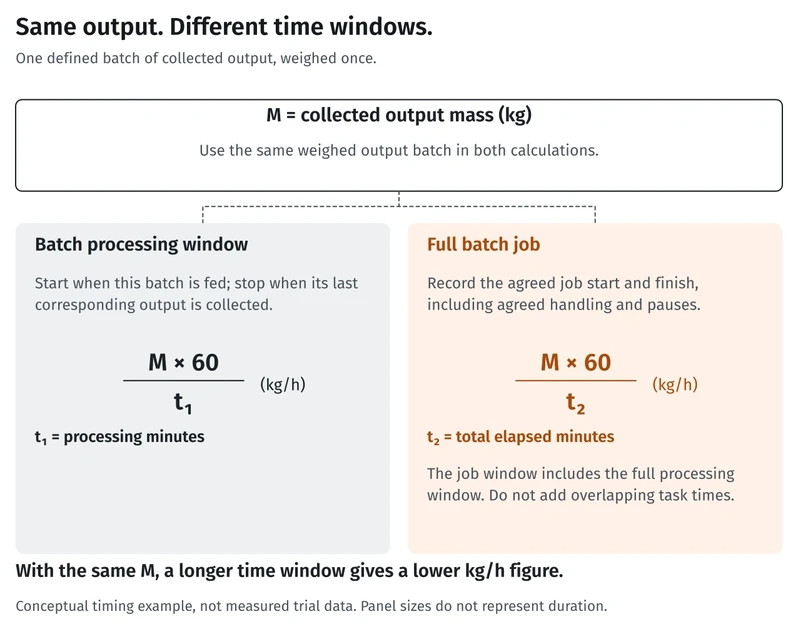
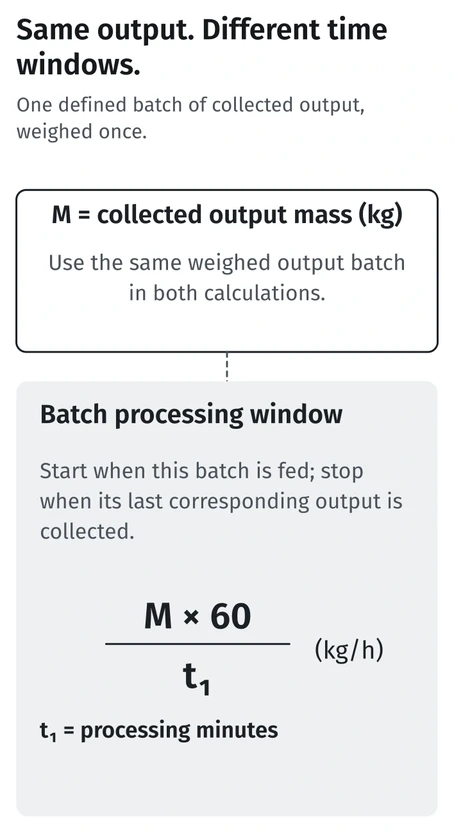
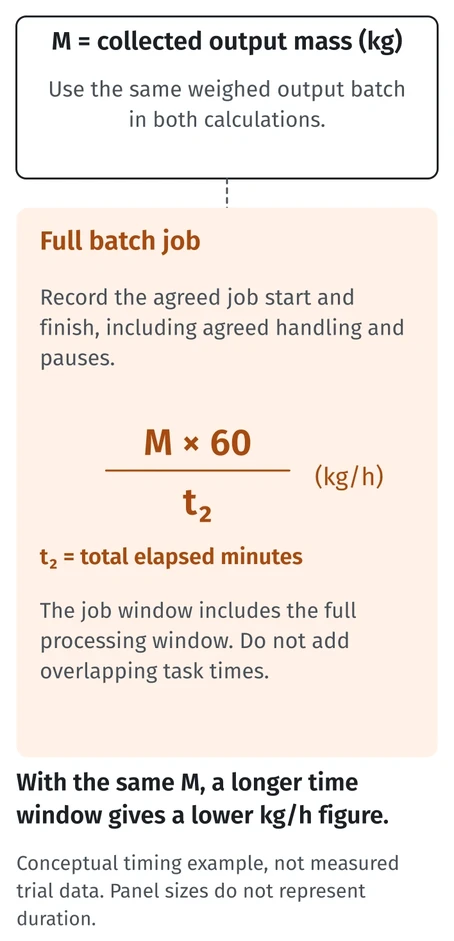
Record total collected output and the part that meets the agreed quality requirement separately, using the same window. Accepted output is a subset of the total, not an extra quantity to add to it. This distinguishes material collected from material suitable for the next process.
Keep a comparison record with every quote
Use the same record for each proposal. Leave unanswered fields blank until the supplier provides the basis.
| Item | What to record |
|---|---|
| Incoming material | Polymer, scrap form and the representative material described or supplied. |
| Part geometry | Dimensions, thickness and any preparation before feeding. |
| Proposed machine | Configuration, screen or other size-control method, feeding and collection arrangements. |
| Output requirement | Intended use, acceptance criteria and observations from an actual regrind sample. |
| Measured mass | Input or collected output; total and accepted output separately where relevant. |
| Measured time | Run duration, start and end events, included pauses and excluded activities. |
| Reported capacity | The kg/h figure and whether it is a catalogue rating, measured result or estimate. |
| Production schedule | Scrap per batch or shift, available granulation hours, arrival pattern and changeovers. |
Close the trial record with a decision
Use one trial reference to link the output sample and its matching records. Alongside each agreed requirement, write the actual observation and any difference still unresolved. Record whether the next step is to obtain specific missing evidence, repeat the trial under agreed conditions, or stop evaluating the proposal. Do not mark an unmet requirement as resolved just because the proposal has been revised. A granulation result alone does not approve regrind for finished-part production.
Decide what the evidence supports
Two kg/h figures are directly comparable only when their material, output requirements and measurement bases are sufficiently aligned. When a difference could affect the result, keep it visible and request the missing basis.
A short run converted to kg/h does not demonstrate an hour of sustained production. A cutting video can show the material and machine behaviour. To calculate the measured kg/h rate, it also needs a matching mass and timing record. An existing written test record should identify the material, configuration, output requirement, measured mass and timing.
For production planning, consider both the quantity generated and the hours actually available for granulation. Scrap arriving together after a batch creates a different workload from scrap arriving gradually. Changeovers between materials or batches also affect the available window. Average demand is not automatically the peak feed demand.
Motor power and cutting chamber dimensions remain useful specifications, but neither is a substitute for throughput evidence. Review the general-purpose granulator model data alongside the capacity basis. For the wider selection process, use our granulator comparison guide.
To discuss equipment with RHONG, send an enquiry describing your material, part dimensions, batch or shift quantity and intended use of the regrind. Have material photos ready for the follow-up.