

Describe the incoming scrap
Identify the polymer and the form of the material: molding sprues and runners, offcuts, rejected parts or bulky waste. Include photographs of a normal batch and the largest pieces. Record dimensions and wall thickness when they affect feeding and cutting.
Also describe contamination or mixed materials. A clean runner from a known resin and a reject containing other components are different applications. Do not use one simple sample to represent every type of waste the machine is expected to process.
Define the required output
State where the recovered material will go. Will it return to molding, feed another recycling stage or be stored for later processing? Include any required particle size or input requirement for the next machine.
Granulation produces cut regrind. It does not carry out washing, melt filtration or extrusion pelletizing. If your process needs those operations, include them in the process description so the granulator's role is clear.
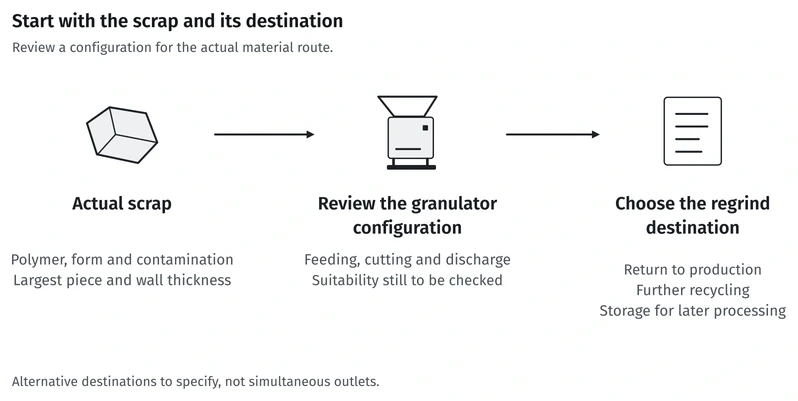
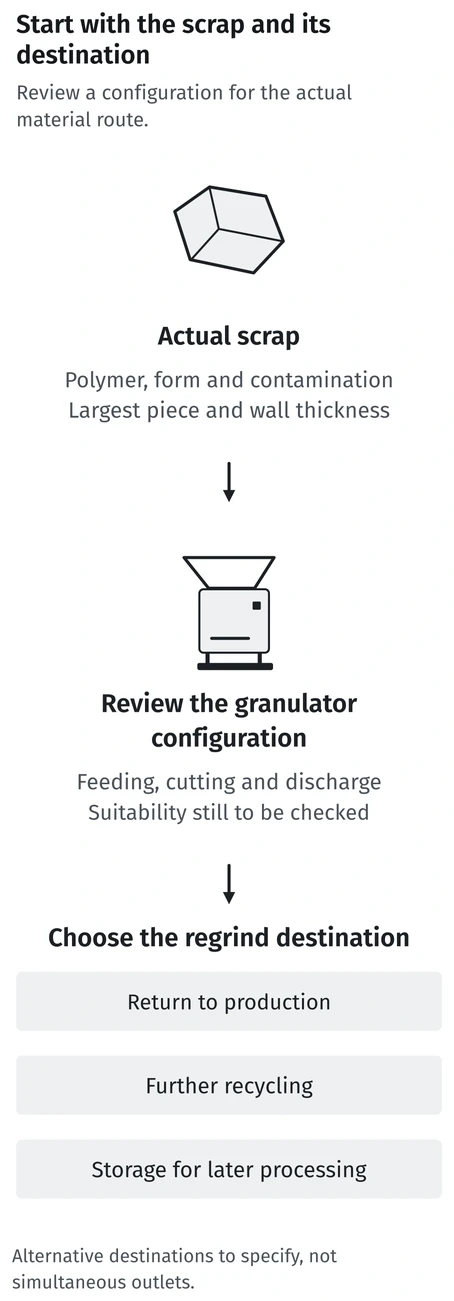
Choose the arrangement around the task
The RG-26E is a general-purpose option for sprues, runners and offcuts. Review the enclosed RG-26GQ where the workshop layout and noise requirements influence the installation. The RG-56E is a heavy-duty range to discuss for larger plastic parts and production scrap.
Where the incoming waste needs an initial reduction stage, consider the RSS shredder as part of the material route. Review the transfer between stages and the output required at each one. These are application directions, not a substitute for checking the actual scrap against a proposed configuration.
For scrap with a specific feeding route, compare the pipe and profile arrangement, film granulators and thermoforming skeleton recycling. For small molding sprues, review the low-speed and screenless configurations against the same sample.
For the workshop layout, compare beside-the-press and central granulation. The screenless versus screened guide separates the cutting constructions. For specific feed forms, use the film-scrap feeding comparison or the purgings size-reduction guide.
Compare capacity figures on equal terms
Give the required hourly processing amount and the operating schedule. Explain whether material arrives continuously or in batches and how it will be fed.
When comparing a quoted capacity, ask which material, piece dimensions, screen, cutting arrangement and feeding conditions were used. A number measured under different conditions may not describe your production task. Motor power alone cannot establish the processing result.
Use the granulator capacity comparison record to keep the measured mass, timing window and accepted output with each kg/h figure.
Check the complete quotation
Review what is included in the proposed supply:
- The exact model and cutting arrangement.
- The screen or other configuration relevant to the required output.
- The feeding method and any equipment included to perform it.
- Regrind collection and transfer to the next process.
- Electrical and installation requirements for your site.
- Operating documents, relevant replacement parts and agreed service scope.
For an enclosed machine, any quoted noise figure should identify the machine, material, operating condition and measurement arrangement. For maintenance and cleaning access, use the documentation for the proposed machine rather than a generic online procedure.
Send a short application brief
You can start an inquiry with a few clear photographs and a written description containing the polymer, largest piece size, required output, hourly demand and working hours. Add a simple layout showing feeding, collection, available space and electrical supply.
If a requirement is not yet known, describe the next process or the problem you need to solve. This gives the factory a useful basis for discussion without turning an estimate into a performance specification.
Send RHONG details of your scrap and production requirements to discuss the proposed model and configuration.
Product references
The equipment examples use RHONG’s published catalog, including the Chinese entries for RG-26E/36E, RG-26GQ/36GQ and RG-46E/56E. Catalog descriptions identify application directions; suitability and supply scope still need to be agreed for the actual material.