Describe the lump before choosing a machine
A solid purging and a thin rejected molding can have similar outside dimensions while presenting very different cutting tasks. For purgings, photographs should show the whole piece and its thickest section. Include the resin grade, fillers and any mixed material rather than reporting only the total weight of a batch.
The aim is to establish both ends of the job: what enters the machine and what the next process can accept. Those two descriptions determine whether one reduction stage is sufficient or whether shredding should precede granulation.
What the two stages do
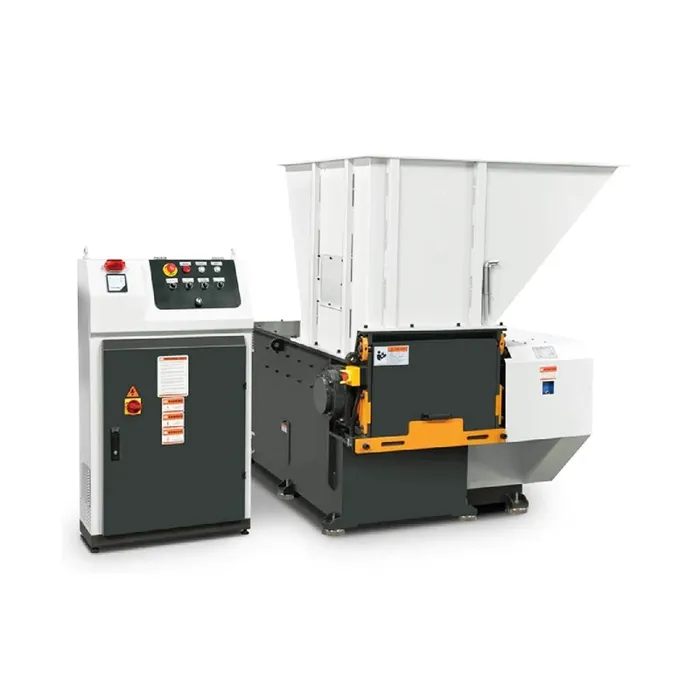
A single-shaft shredder provides an initial reduction route for plastic lumps and purgings. RHONG's Chinese catalogue describes this application and allows for a granulator to follow where further size reduction is needed.
A granulator cuts material into regrind. A heavy-duty granulator may be considered for production scrap, but the actual piece must suit the proposed feed opening and cutting arrangement. Neither the label “heavy-duty” nor motor power alone establishes that a particular solid lump can be processed directly.
Two stages are therefore an option to evaluate, not a rule for every purging. If one proposed machine can accept the incoming material and deliver the required regrind under the agreed conditions, an additional reduction stage may be unnecessary.
Separate machines or a combined arrangement?
With separate machines, the quotation needs to define the transfer between the shredder and granulator, as well as how material leaves the second stage. Comparing each machine's nominal hourly output separately leaves that connection unresolved.
A combined shredder-granulator brings both operations into one equipment arrangement. It still has two cutting tasks. Review the proposed feed route, access for cleaning and maintenance, discharge method and electrical requirements for the complete unit. A combined layout does not establish the processing result for an unspecified lump.
Agree what counts as usable output
Specify the next destination: storage, another recycling operation or a defined production process. Mechanical size reduction does not wash the material, remove every contaminant or melt-filter it. Cut regrind is also different from pellets made through extrusion and pelletizing.
For a sample evaluation, define the incoming material and the output you need to assess. Include particle-size requirements where relevant, material condition and the intended processing rate. Retain those conditions alongside any measured result so that later quotations refer to the same task.
Prepare the application brief
- Typical and largest pieces, with dimensions and the thickest section.
- Resin grade, fillers, contamination and the condition and temperature of the material presented for processing.
- Batch size, how often it arrives and the required output destination.
- Available space and the proposed feeding, transfer and collection route.
Source
RHONG Chinese catalogue: single-shaft shredders for lumps and purgings. The catalogue describes separate and combined use; the final machine and process specification remain application-specific.