

Consider direct granulation for clean, empty HDPE production drums if the largest and hardest-to-feed drums pass repeatedly and the regrind meets your reuse specification. If whole drums repeatedly interrupt the run, trial pre-cut feed and a shredder followed by a granulator. Use the same regrind acceptance criteria and include preparation time and feeding interruptions when you compare the routes.
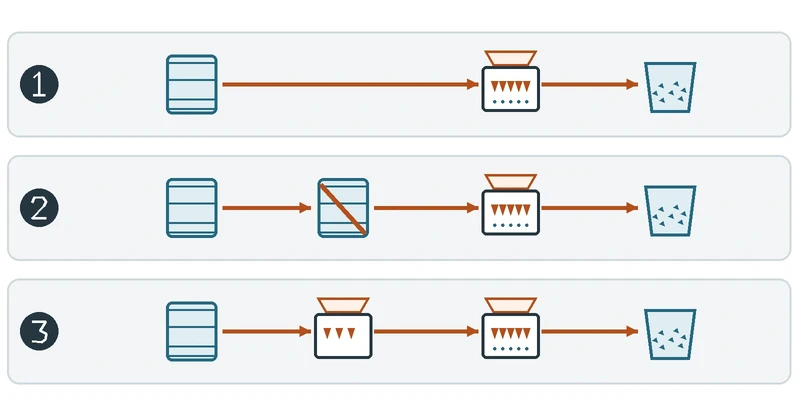
Define the result before testing
Agree on particle-size distribution, any fines and cleanliness limits, the sampling method and the minimum kilograms of accepted regrind per elapsed hour. Use the same method for sampling and grading the output from each route. Match machine screens where possible and record any differences. Weigh accepted output and record total elapsed time, including pauses and refeeding. Measure each route from original scrap to accepted regrind, including real preparation labor and waiting time.
A pre-cut sample supplied ready for a machine trial can show the granulator's rate on that feed. To compare routes, also measure how much feed the preparation station can supply over a representative shift, and whether preparation and granulation run in parallel or share people and time.
Three routes to compare
Whole drums to a granulator. This avoids a separate preparation stage if parts feed consistently and the output meets the specification. Watch several pieces in succession: a round drum may roll or shift, while a handle or flange may change how it enters. Opening dimensions alone do not describe how the cutting chamber handles the part; see the feed opening and cutting chamber guide.
Pre-cut feed to a granulator. Test pieces made by the factory's actual preparation process. Record their shape and size, the preparation rate and the labor required. A successful test with prepared pieces does not establish that whole drums can feed directly.
Shred first, then granulate through a screen. Coarse reduction can make bulky parts easier to handle, but intermediate pieces still have to reach the granulator. Record the combined route through to accepted regrind, including transfers, interruptions and refeeding. Reduced bulk alone is not the same as material accepted for reuse.
A hypothetical quotation comparison
Suppose a whole-drum route produces 105 kg of accepted regrind over one elapsed hour, including stops. The pre-cut route produces 145 kg of accepted regrind in a 60-minute granulator-only test from a container of pieces prepared beforehand. At the factory, however, its cutting station can supply only 90 kg of the same material per hour in a form the granulator can accept.
If both stations run continuously and preparation is the only source of feed, the line can sustain at most 90 kg/h of accepted regrind after the initial stock of pre-cut pieces is used up. Any rejects or losses cut that rate further. The 145 kg/h machine trial helps size the granulator. The 90 kg/h preparation rate sets the line’s upper limit in this example.
Make the trial represent a shift
Use a representative batch from the same known material source for all three routes. Include typical and largest parts, record their dimensions and weight, and show handles and flanges. Include potentially nested pieces only when the supplier has approved the proposed feeding method for them. Agree on feeding orientation and applicable operating procedures before the trial. Use multiple pieces in the form and sequence they would actually arrive, and log pauses, refeeding, preparation time and accepted output across the run.
Give each supplier the same trial record and agree on the acceptance criteria before the run.
| Trial record | Whole-drum granulation | Pre-cut granulation | Shred then granulate |
|---|---|---|---|
| Sample count and feed form | |||
| Accepted regrind (kg) | |||
| Elapsed time from original scrap to accepted regrind (min) | |||
| Feed interruptions (count and total minutes) | |||
| Accepted regrind per elapsed hour (kg/h) | |||
| Route-specific check | Repeated feeding of the hardest shapes | Preparation rate, labor and whether both stations can run together | Transfer between stages |
When a trial starts with prepared or pre-shredded stock, label the reported rate as a machine or stage rate. Record any preparation or transfer time outside that test before comparing whole routes.
Send the material identification and known history, dimensions, weights and photos, sample count, planned run time, reuse limits, proposed screen and the agreed sampling method. Identify separate fasteners or non-HDPE components and handle them under the factory's existing procedures. Drums that held unknown or hazardous contents require a separate assessment.
For a supplier discussion, see the large-capacity granulator and the single-shaft shredder. Bring the dimensions, photos, reuse criteria and trial notes when you submit an inquiry. For solid resin lumps, see shredders and granulators for purgings.