

Get the instructions for the actual grade
Record the resin supplier, grade designation and any masterbatch, additives or regrind in the feed. Obtain the drying instructions for that material, including temperature, time and any specified moisture or drying-air conditions.
A polymer name alone is not a drying specification. Different grades and blends can have different preparation requirements. This guide does not prescribe a universal temperature or drying time; those values belong to the material instructions and the proposed process.
Separate material consumption from hopper capacity
State how much material the processing machine uses per hour and how many hours it operates. Include the drying time in the material instructions and whether one dryer will serve one machine or several.
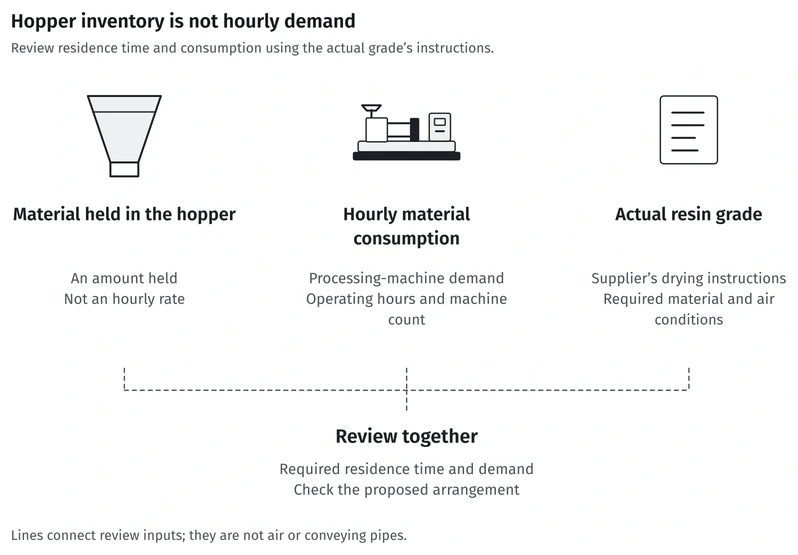
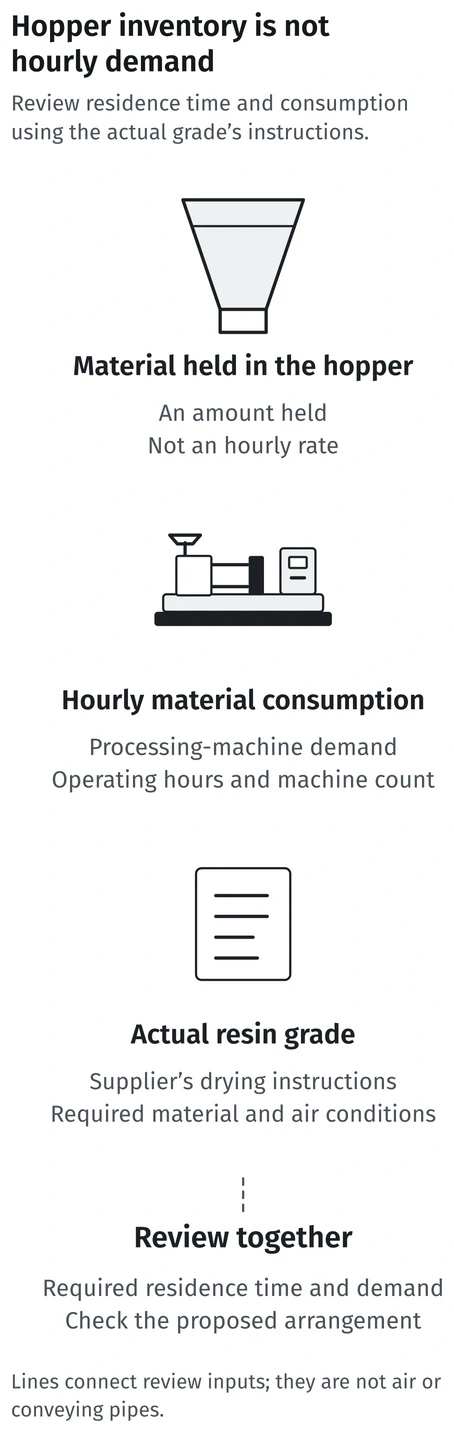
The amount of material held in a hopper is not the same as hourly consumption. The required residence time and demand need to be considered together when reviewing the proposed arrangement. If you only know the production-machine output, describe that process rather than guessing a dryer size.
Review the drying method
The RDM hopper dryer provides a hot-air drying arrangement. The RDC range combines drying and dehumidification. Review the required drying-air conditions for the resin when comparing them.
Where the supplier requires dehumidified air, do not assume ordinary hot-air drying is equivalent. Equally, a lower advertised dew point does not by itself establish the full drying result. Check the proposed operating conditions, material demand and any options attached to a stated value.
A cabinet dryer offers a tray-loading workflow for small batches. A standalone rotor dehumidifier supplies treated air to a compatible hopper. The combined dryer and dehumidifier and dryer and loader have different component scopes; choose from the resin instructions and material route.
Draw the material route
Show where material is stored, how it enters the dryer, where the receiving hopper stands and how resin reaches the processing machine. Include horizontal and vertical transfer distances where conveying is part of the inquiry.
A vacuum autoloader may be discussed for pellet transfer, but its configuration needs the actual material and route. If the feed contains powder, flakes or an irregular blend, describe it explicitly. For layout choices, see the vacuum loader selection guide.
Make the supply boundary clear: drying equipment alone, or drying together with material loading and transfer. Identify existing hoppers, loaders and controls that the new installation must work with.
Information to include in the quotation review
- Resin supplier, grade and drying instructions.
- Hourly consumption, operating hours and number of processing machines.
- Proposed dryer model and drying-air arrangement.
- Hopper arrangement and intended material residence conditions.
- Included loading and conveying components, with their connection points.
- Electrical supply, installation space and applicable operating documentation.
Where a drying result is essential to the production process, agree what result is required and how it will be checked under the stated conditions. Avoid treating an equipment description as a guarantee for an unspecified material.
Prepare the inquiry
Send the material data sheet or grade designation, the supplier's drying instructions and your consumption figures. Add a layout or photographs of the feed source, proposed dryer position and receiving equipment. Name any figures you still need help defining.
Send RHONG details of your resin and process to review a drying configuration for the application.
Product references
RHONG’s Chinese catalog describes the hot-air arrangement of the RDM hopper dryer and the combined functions of the RDC dehumidifying dryer. These equipment descriptions do not replace the drying instructions for the actual resin grade.