
Choose a vacuum hopper loader for plastic pellets by answering two questions: where can the vacuum unit and receiver fit, and how many receiving points need material? A separate loader can serve one point; adding receivers is a different configuration decision.
Where will the vacuum unit sit?
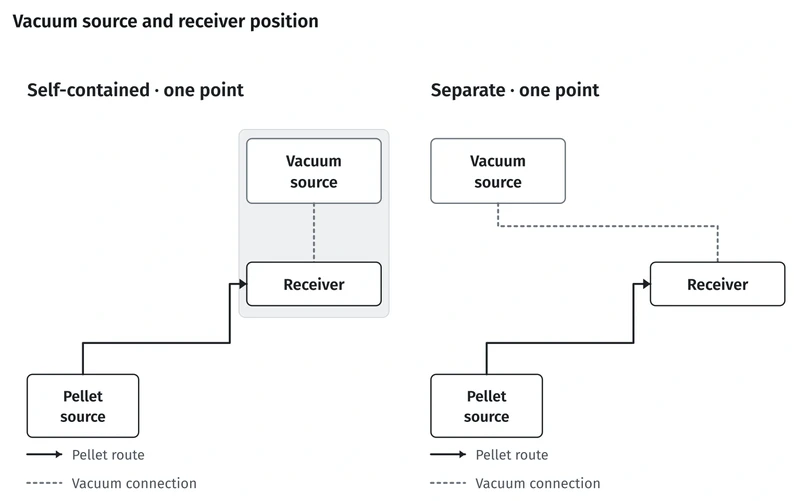
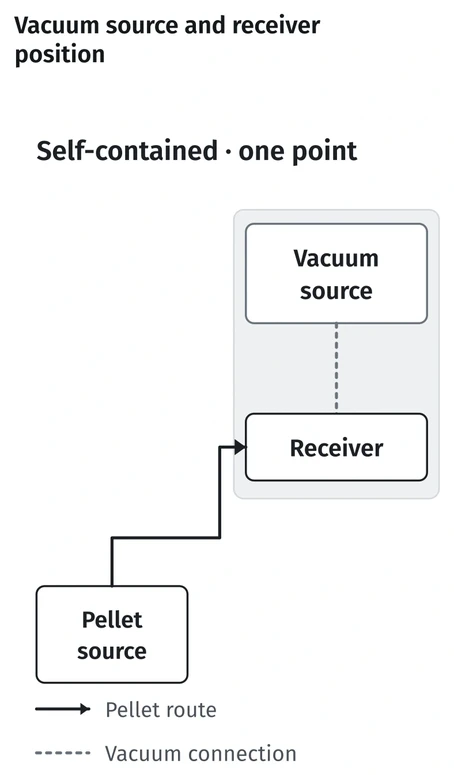
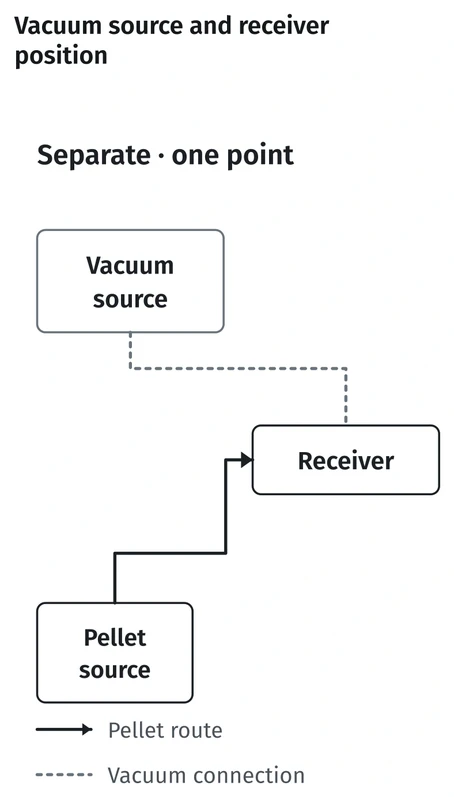
A self-contained loader combines the vacuum source and receiving hopper. A separate arrangement places the vacuum unit apart from the receiver. Check the space and cleaning access at both positions. An accessible vacuum unit on the floor does not make an elevated receiver accessible.
RHONG's self-contained I, U and U2 branches are distinct references. For separate arrangements, compare the RAL-300, RAL-303/503, K and KU branches or RAL-703/903 range against the actual route. Keep the full model suffix: RAL-300 and RAL-300I are different references, and a K configuration is not automatically a KU configuration.
How many points need material?
| Arrangement | What to establish |
|---|---|
| One receiving point | Choose the installation layout and match the route to that point's consumption. A single point may use a separate loader. |
| Two receiving points | Show when each point calls for material and where their demand overlaps. |
| Several receiving stations | Identify each route, demand and loading sequence, including how competing calls are handled. |
RAL-323/523 and RAL-323K/523K are named one-unit, two-receiver arrangements. RAL-703K4 is described for up to four receiving stations. Receiver count does not establish simultaneous delivery. Some shared-vacuum systems load points in sequence; ask how the proposed controls serve machines that consume material together.
Two receiving points also do not mean two ingredients are being metered into a blend. Destination count, material selection and recipe proportioning are different requirements.
Measure the route, not just the distance between machines
Mark the material source, receiver and vacuum unit on a layout. Record the horizontal pipe run, vertical lift and bends. These affect the conveying duty alongside pellet form, bulk density and consumption. A straight-line measurement leaves out much of the route.
The destination may be a dryer or a process hopper. If drying is part of the line, show where loading occurs in the resin-drying route; conveying the material is not the drying step.
Keep hopper volume and conveying rate separate. Litres describe storage volume; they do not establish kilograms delivered per hour. Neither the installation label nor receiver count establishes a universal distance or throughput.
Use the same brief for each quotation
| Input | Details to provide |
|---|---|
| Material | Resin, pellet form and bulk density at each receiving point. |
| Demand and timing | Consumption and operating schedule at each point; mark machines that run together. |
| Complete route | Locate the material source, receiver and vacuum unit; give horizontal runs, vertical lift and bends. |
| Receivers and installation | Number and positions of receivers, mounting space and cleaning access. |
| Electrical supply | Available electrical supply at the installation. |
| Existing equipment and scope | Equipment to retain; receivers and connections to include in the quotation. |
| Models and controls | Ask the supplier to state full model references, including suffixes, controls and the loading sequence for overlapping demand. |
Compare those proposals against the same route and demand. Powder and irregular regrind need a separate review of separation, filtration and discharge rather than automatic approval from a pellet-loading specification.
Download the vacuum loader project checklist (PDF). Use the same checklist for each quotation; print it or share it with the layout.
Send the layout and point-by-point requirements through our equipment inquiry.