
Air-cooled and water-cooled chillers can both supply chilled process water to plastics equipment. The difference is where the condenser sends the heat. Compare that heat-rejection route and the equipment it requires before choosing a model.
Keep the process circuit and heat rejection separate
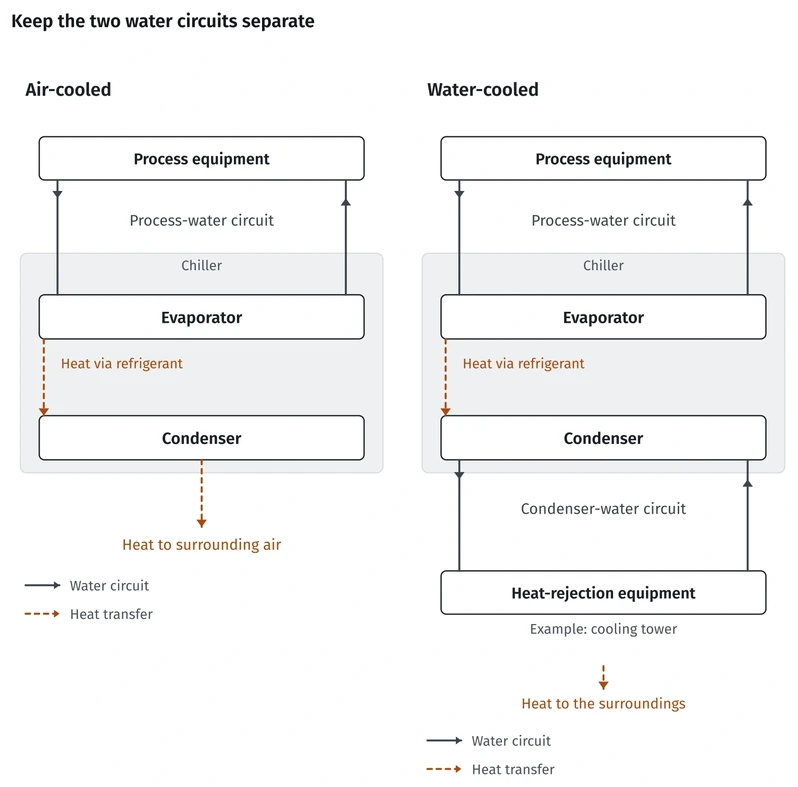
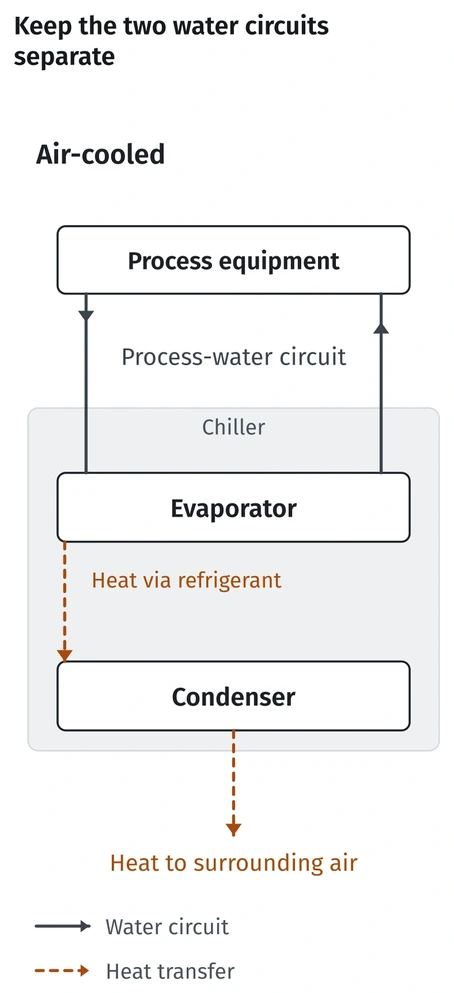
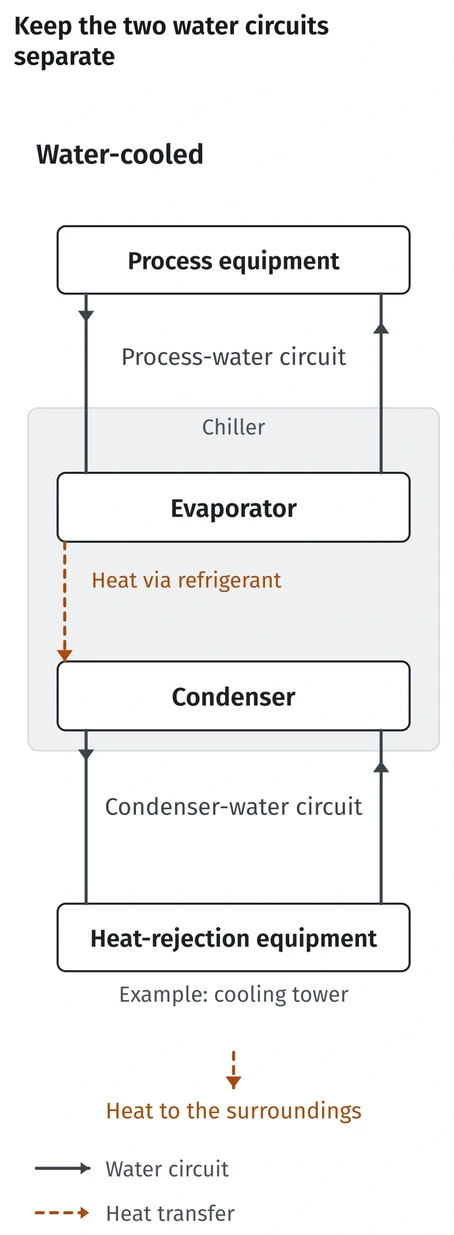
Process water brings heat from the equipment back to the chiller. At the evaporator, that heat passes to the refrigerant and travels to the condenser. An air-cooled condenser releases it to the surrounding air. A water-cooled condenser transfers it to a condenser-water circuit.
For a chiller-and-tower layout, place the RCT cooling tower on the condenser heat-rejection side. The tower is not necessarily the equipment supplying the required chilled process water. Other engineered water-cooled layouts may use dry cooling or heat recovery; a tower is one option.
Which heat-rejection route can the site support?
| Arrangement | Site information to review |
|---|---|
| Air-cooled condenser | Surrounding temperature, air inlet and outlet positions, and a route for warm discharge air to leave the installation. |
| Water-cooled condenser | Condenser-water temperature, flow and quality, service access, and the equipment that ultimately rejects the heat. |
For an air-cooled unit, check more than cabinet space. Show the airflow route and where the discharge air goes. For a water-cooled unit using an existing condenser-water circuit, provide that circuit's conditions separately from the process-water requirements.
If the condenser-water circuit is absent, include the additional heat-rejection equipment and connections in the project scope. A factory's location alone cannot decide between the two arrangements.
Scroll or screw is a separate choice
Air and water describe condenser cooling; scroll and screw describe compressor types. RHONG's four catalogue families keep these two dimensions separate:
| Compressor | Air-cooled | Water-cooled |
|---|---|---|
| Scroll | RCM-A | RCM-W |
| Screw | RCMC-A | RCMC-W |
Machine-side versus central cooling describes how cooling is arranged and distributed. It is another layout question, not a consequence of the condenser label. For a shared system, show the machines that operate together, their required water temperatures and the supply and return routes.
Compare the complete system at the same conditions
Give each supplier the required process-water supply and return temperatures, flow and heat load, including the simultaneous operating demand. A target supply-water temperature does not mean every chiller model can deliver it at the required load. Ask for cooling capacity at that supply temperature and process-water flow, with the condenser-inlet air temperature for an air-cooled unit or the condenser-water temperature and flow for a water-cooled unit. If a catalogue rating uses different conditions, request selection data for your operating conditions before comparing capacities. Tank volume describes stored water, not cooling duty.
The quotation should identify which chiller, pumps, tank, heat-rejection equipment, piping and controls are included. A list of system components does not mean that every item comes as standard with the chiller. Mark what the factory already has and which connections remain part of the installation work.
If the line includes a mold temperature controller, show its role too. It manages its connected mold circuit; a chiller supplies separate cooling where required. Keeping those responsibilities distinct helps define the supply boundary.
Use our equipment inquiry to send the operating requirements and site layout for a cooling proposal.